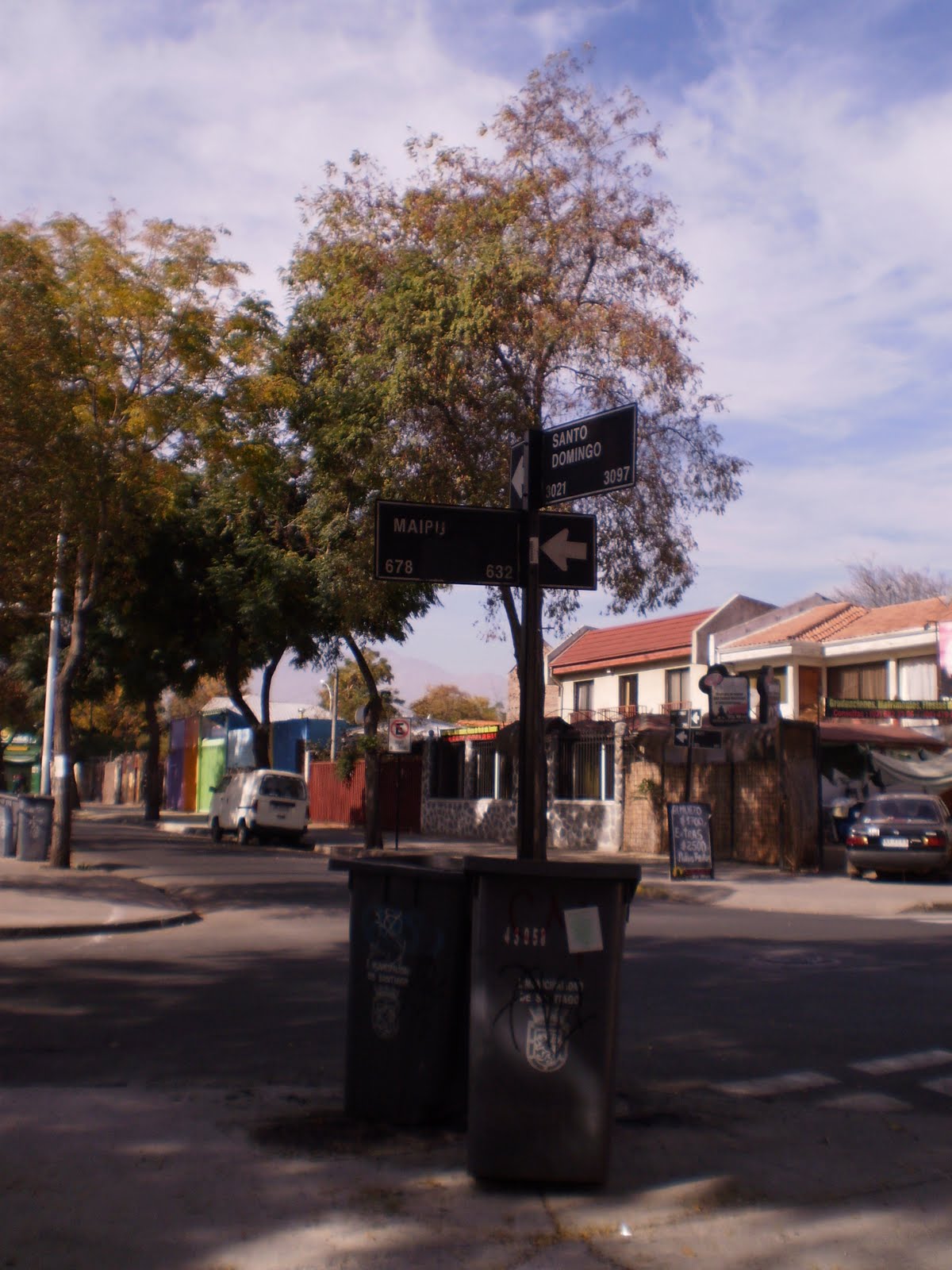
Santiago is a different world on Sundays as most people get out of the city or spend the day indoors with the family. The streets are much quieter and emptier than on other days, most things are closed including restaurants and bars (as opposed to the popular English Sunday boozing), and, provided you´re in the right spot, there´s a real mellow feel to the place. But it can sometimes be difficult to find a new place to wander around in that aimless and leisurely Sunday style if you´re not too familiar with things and don´t want to take your stroll in San Cristobal or Parque Forestal every weekend. So what else is about?
As I may have written before, more or less my favourite part of Santiago is Barrio Brasil and neighbouring Barrio Yungay. Plaza Brasil is well-known, stages regular weekend events, and has a heady nightlife, but just a few blocks north-west lies Plaza Yungay, a lovely chilled-out place tucked away in the old part of the city. The streets round here still feature the once-grand but now-shabby houses of the old moneyed classes from the early part of the 20th Century, before they headed off to the likes of Las Condes and Vitacura. The colonial architecture, tree-lined cobbled streets, brightly-painted murals and smattering of workshops, cultural centres and local community groups gives this area a strong sense of character and local pride, evident in the attitude and conduct of the residents. Having moved here recently from sterile Providencia, I noticed straight away how many people struck up conversation with me in shops or cafes.
There is, however, a somewhat seedy reputation that attaches itself to this part of the city. I was warned about moving here as it could be dangerous at night, and there are a much higher ratio of botillerias (off-licenses) than in other parts of the city, not to mention the side-alley hotels which have rooms available to rent by the hour. Yet it is easy to avoid this side of things (although I may visit a botilleria of my own free will), and these kinds of claims are generally made by people less familiar with the area. It certainly doesn´t seem to be any worse than, say, living in Hackney or some such part of London. What does set it apart from various London barrios is that it manages to be bohemian without being bourgeoise, and the general charm and tranquility is much more appealing than in other parts of Santiago. In spite of what some people might say, it is round here that I feel most relaxed and at ease.
Owing to its history of earthquakes and then economic 'progress', the majority of 'old' Santiago is these days sadly just a memory, but photos and preserved barrios such as Yungay are testament to the fact that it was once a rather attractive city. It is definitely a place to check out and get to know more and more.
And so, last night, Santiago was once again the scene of the police teargassing and watercannoning demonstrators in Plaza Italia and the city centre. This is a regular occurence in Chile, where it seems that most large-scale public protests seem to end with rocks thrown, heads broken and cells full. I wasn´t there last night but I´ve seen this kind of thing before, the first time being in the World Cup last year when football fans smashed up Plaza Italia following Chilean victories before again smashing up Plaza Italia following Chilean defeats. I found it Warner Brothers-esque, the way that things went round in a circle and repeated themselves. The fans overindulge and get rowdy, the police presence increases, the fans get more boisterous, the police attack, the fans run off and order is restored. Then the process started again a couple of days later. The whole thing reminded me of Wile E. Coyote and his forever backfiring attempts to catch Roadrunner.
But yesterday´s protestations and clashes were focussed on a more serious and contentious issue: the government approval of the Hydroaysén project in Patagonia in the south of Chile that will have a huge environmental impact. This will see the construction of five hydro-electric plants in some of the most pristine natural land in the country. Many opponents of the project argue that it is not necessary as the time it would take to construct the plant could be chanelled into developing alternative sources of energy. There is also the environmental impact and the potential harm likely to be caused to this region famed for its beautiful wilderness and to the communities that live there. For its part, the governent argues that by the year 2020 the project will generate around 20% of the country´s energy supply and is an important part of Chile´s future progress.
So public anger was manifested last night not only through clashes in Santiago, but also in Valparaiso and Concepción. The concept of public protest is strong in Chile, perhaps owing to the years of suppresion endured under the dictatorship that prohibited this basic right. Yet why does it so often seem to end in chaos? Is it due to, as the authorities would claim, an element of trouble-makers whose primary goal is to cause conflict and disturbance? That was clearly the case during the alcohol-fuelled World Cup disturbances, yet when it comes to serious political issues and people feeling their views are not taken into account, does it become acceptable to turn to more extreme measures of protest? And what role do the police, los carabineros, play in all of this?
Chile´s carabineros have a decent reputation by the standards of Latin American policing, probably due to military training and better salaries than in other countries that results in less corruption. But there is something unsettling about the green military uniforms and guns used by all law enforcement and it is perfectly normal to see heavily armoured police at low-key public events. It strikes me as strange that a country with such a turbulent and traumatic history under a military dictatorship still entrusts its law enforcement to military figures and there´s no denying that los carabineros look more like soldiers than police. Could it therefore be that their mere presence is enough to incite empassioned crowds?
As well as the guns, shields and helmets, there are the brutal looking vehicles, which wouldn´t seem out of place in a Mad Max film. Dark green armour-plated buses are stationed close to demonstrations or in busy late-night areas, a show of force but also an act of provocation. Then there are the famous ´guanacos´, named after the llama-like spitting animals of the Andes, with their powerful water cannons and eternal presence at public events. These machines hark of a totalitarian state and evoke a heavy sense of menace.
It is not only the image of the police force that is distasteful but also its conduct. I was in Plaza Brasil on Sunday at the Communist Party flea market (a future blog entry on its way), where locals sell old clothes or books or cakes, students promote their own comics and artwork, local musicians soundtrack the afternoon, and hordes of kids enjoy the playground. The event couldn´t be tamer and, were it not for the identity of the organisers, would be utterly ignored by the police. However, what with this being Barrio Brasil, armoured and armed carabineros wove among the families and teenagers on powerful motorbikes while a police 4x4 drove directly through the centre of the children´s play area. To say this was unnecessary would be an understatement. It would certainly never happen at a Sunday afternoon family event in upmarket and conservative Las Condes.
It is this kind of oppressive heavy-handedness that makes me suspect public disturbances such as last night´s events in Plaza Italia are not solely down to troublemakers amongst the protestors. It strikes me that the authorities are likely to provoke violence as it is this that, as in the UK, attracts the media focus and helps to diminish support for those that oppose the government. The result is lower attendances on subsequent demonstrations and the loss of public sympathy. We should remember that large parts of the Chilean, and global, media are controlled by the upper classes, those who benefit from government policies that anger the masses, and there is a high degree of collusion.
In the meantime, there is a protest against the Hydroaysén project planned for the 21st May. I´ll be there and will blog on it, provided I don´t burn my fingers from all the molotovs I´ll be carrying.
One of my favourite bars in Santiago is Cafe Brazil, this cool rickety old place with walls plastered with posters of long-gone festivals and demonstrations, obligatory Chilean leftist iconography of Che Guevara, Victor Jara and Salvador Allende, and the scribblings of years of beatnik intellectual contemplation (to be honest I haven´t got round to reading the walls and it could just as well be Jose 4 Sonia or Diego woz 'ere although the bohemian vibe and sixties and seventies political slogans allows you to suspect such a thing). The bar is mellow, there´s live music most nights (bands, singers and spontaneous jams), cold and reasonably priced beer, healthy measures of pisco, and complimentary popcorn of the highest calibre! So, all in all, it´s a pretty swinging joint.
I guess Cafe Brazil is a bit of a local institution whose regulars have been going there for years. It started out as a smaller cafe in Plaza Brasil and became a venue for political meetings and discussion, as well as other themes, due to a lack of alternatives in the barrio. Over time the place started to get more popular with students, musicians, writers and artists, gradually developing into a centre of left-wing politics and alternative culture. It´s small size eventually became a problem and they moved around the corner to bigger premises in Avenida Cumming, in a building previously the headquarters of one-time presidential candidate for the Communist Party, Gladys Marin, and subsequently used by other affiliated political groups. It remains there today and is typical of the shabby but charming old buildings that make up this part of Santiago.
They put on a lot of decent music on most nights of the week, with Chilean folk and andina musicians very popular and welcome thanks to their intrinsic links with the left-wing political movement. There is also regular poetry, dance classes, theatre workshops and so on. It also maintains its political identity: outside in the street there is a display which documents the positive steps taken by the socialist administration of Allende to improve the lot of the people and the subsequent reversals implemented by the dictatorship. Then there´s this old boy, who I take to be the dueño (landlord), who wanders around the tables stern-faced and impeccably dressed. For me, this is what a bar should be: venue, meeting place, cultural and community centre and workshop.
There are a lot of nice bars and places to eat in this part of town but Cafe Brazil is pretty unique. It´s also my new local as I just moved in around the corner and expect I´ll be heading there regularly in the evenings. Last night there was this female group who mixed it up a bit with traditional andina songs and then some cumbia. I´m not sure what´s on this weekend but it doesn´t matter, you can just head over and pay a couple of luca on the door and there´s likely to be something interesting going on. The link to the website´s at the side of the page to the left. Definitely a good place.